The Health and Safety Executive (HSE) published its annual statistics on work-related ill health in Great Britain on 19th November 2026. Musculoskeletal disorders (MSDs) are conditions affecting the muscles, joints, tendons, ligaments and nerves. They remain the second largest cause of work-related ill health after stress, depression or anxiety.
At first glance the 2025/26 figures look like progress, because fewer workers reported an MSD than last year. A closer look shows a more complicated picture. There are fewer cases, but more working days are being lost, and lower limb disorders have risen sharply.
The Headline Figures: 2025/26 Compared With 2024/25
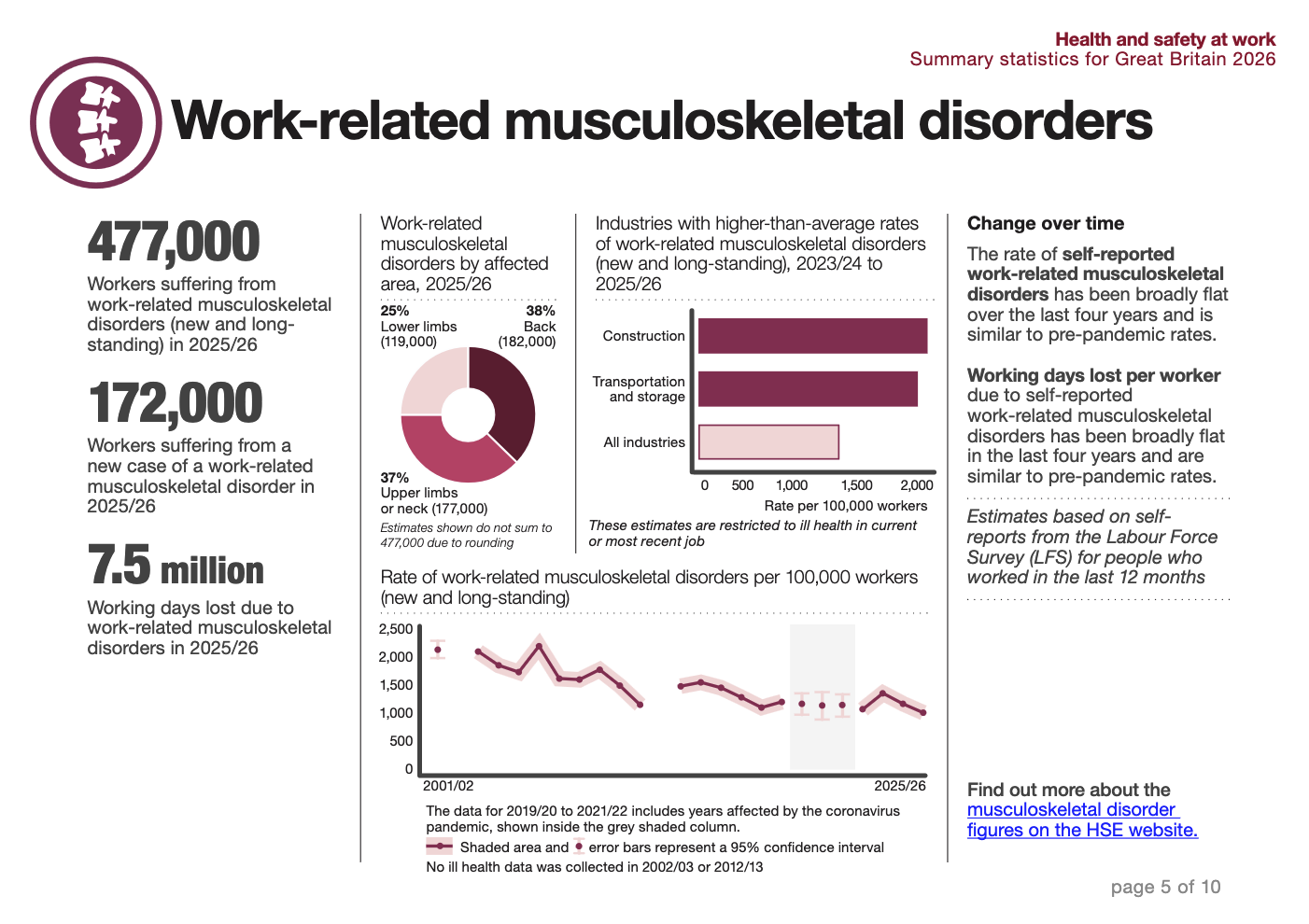
Workers with a work-related MSD (new or long-standing): 477,000, down from 511,000
New cases: 172,000, compared with 173,000
Working days lost: 7.5 million, up from 7.1 million
Average working days lost per case: 15.7, up from around 14
Share of all work-related ill health: 26%, down from 27%
Share of working days lost to work-related ill health: 21%
MSDs by Body Area
Back: 182,000 workers (38%), down from 221,000 (43%)
Upper limbs or neck: 177,000 workers (37%), down from 211,000 (41%)
Lower limbs: 119,000 workers (25%), up from 78,000 (15%)
These estimates come from self-reports in the Labour Force Survey and cover Great Britain. HSE notes that the body area figures do not add up exactly to the total because of rounding.
What's Changed
Fewer Cases, Longer Absences
The number of workers with an MSD fell by 34,000, but working days lost rose by 400,000. On average, each case now accounts for 15.7 days off work. For employers, that means longer absences, more cover to arrange and more disruption for each person affected.
Lower Limb Disorders Have Risen Sharply
Lower limb disorders, which HSE describes as affecting the hip, thigh, knee, calf, ankle or foot, are the standout change this year. They rose from 78,000 to 119,000 workers. They also cause the longest absences, at 21 days per case. Lower limb disorders make up 25% of MSD cases but 33% of the working days lost to MSDs.
Upper Limb and Neck Disorders Remain a Major Issue
An estimated 177,000 workers in Great Britain had a work-related upper limb or neck disorder in 2025/26, which is 37% of all work-related MSDs. That is fewer than last year, but upper limb and neck disorders still affect more than a third of all workers with an MSD. Each case averages 13.1 days lost. HSE identifies manual handling, awkward or tiring positions and keyboard or repetitive work as the main causes reported by workers.
A Flat Long-Term Trend
HSE describes the rate of self-reported work-related MSDs as broadly flat over the last four years and similar to pre-pandemic levels. So this year's fall in total cases should not be read as a turning point. There are still 172,000 new cases every year.
What This Means for Businesses in Northern Ireland, the UK and Ireland
The HSE figures cover Great Britain only. Northern Ireland statistics are published separately by HSENI, and I cover the latest figures in my analysis of the HSENI 2026 MSD statistics. The same risks apply to workplaces in Northern Ireland and Ireland: manual handling, repetitive tasks, prolonged standing and poorly set up workstations.
The Cost of MSDs
HSE does not publish a separate cost figure for MSDs. It estimates that workplace injury and new cases of work-related ill health cost Great Britain £24.6 billion a year (2024/25, in 2025 prices). MSDs account for 7.5 million working days lost, which is 21% of all days lost to work-related ill health. For an individual business, the cost shows up as absence, reduced productivity, recruitment and cover, and potential claims.
Higher-Risk Industries and Occupations
HSE reports an average rate across all industries of 1,180 MSD cases per 100,000 workers (2023/24 to 2025/26). Two industries are higher than average:
Construction: 1,940 per 100,000 workers
Transportation and storage: 1,890 per 100,000 workers
By occupation, the highest rates are in:
Skilled trades: 2,520 per 100,000 workers
Process, plant and machine operatives: 2,190 per 100,000 workers
Elementary occupations: 1,770 per 100,000 workers
Caring, leisure and other service occupations: 1,710 per 100,000 workers
If your business relies on manufacturing and production lines or retail and warehouse operations, these figures are directly relevant to your workforce.
Your Legal Duties
Employers have a legal duty to assess and reduce MSD risks. This includes the Manual Handling Operations Regulations 1992 and the Health and Safety (Display Screen Equipment) Regulations 1992 in Great Britain, and the equivalent Northern Ireland regulations. In Ireland, the Safety, Health and Welfare at Work (General Application) Regulations 2007 cover manual handling and display screen equipment.
Prevention: Where to Focus
Assess the task, not just the person. A structured workplace assessment identifies the risk factors in the job itself, such as force, repetition, posture and duration.
Look beyond lifting. The rise in lower limb disorders is a prompt to review prolonged standing, walking, kneeling, squatting and climbing, as well as lifting and carrying.
Provide appropriate, task-based manual handling training. Generic training rarely changes behaviour on its own. Manual handling training built around your actual tasks is far more effective.
Don't overlook desk-based work. Upper limb and neck disorders remain common, and office and remote working setups need regular review.
Build internal capability. Ergonomics Champions can spot problems early and keep improvements going between formal assessments.
Encourage early reporting. The longer a problem goes unreported, the longer the eventual absence is likely to be.
Why Chartered Ergonomist Expertise Matters
Chartered status from the Chartered Institute of Ergonomics & Human Factors (CIEHF) shows a recognised level of professional competence in assessing and designing work around people. As the only Chartered Ergonomist operating in Northern Ireland, I bring experience from production environments including Airbus UK and Aston Martin, as well as office and DSE settings. That experience helps me find the risk factors that generic assessments often miss, and recommend practical controls that work on the shop floor and at the desk.
Taking Action
Review your MSD risk assessments against current tasks, not last year's.
Check whether your assessments cover lower limb risks, as well as back and upper limb risks.
Look at your absence records for MSD-related patterns.
Make sure manual handling training is task-based and up to date.
Get specialist support where the risks are complex or recurring.
If you would like to discuss MSD prevention in your workplace, Contact Julie Rainey.