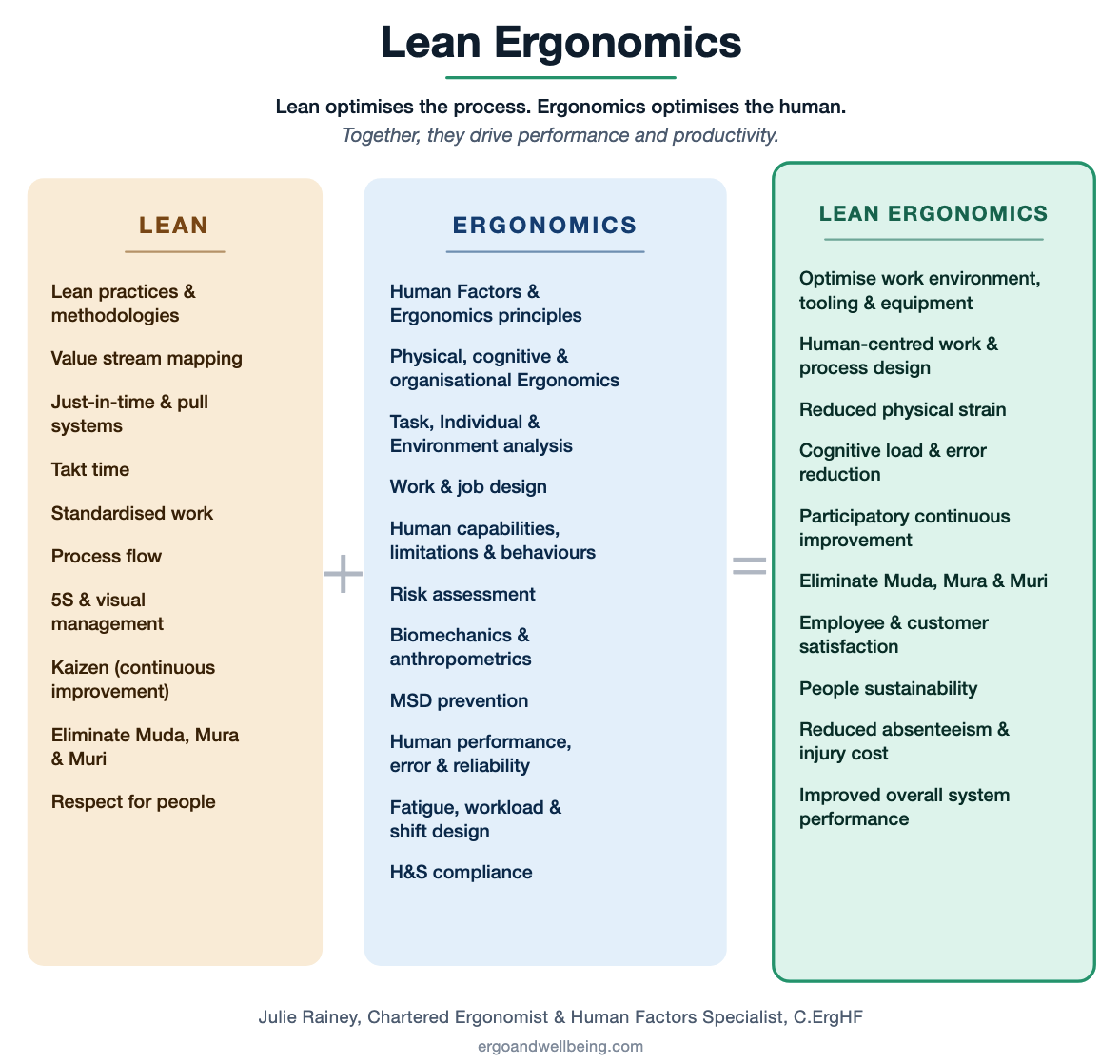
Want to get more from your Lean programme? Integrating Ergonomics is how.
Most Lean programmes are excellent at identifying process waste. Far fewer are designed to identify the waste created by a poorly designed work environment, inadequate tooling or equipment that doesn't fit the people using it.
And yet the signs are there on every production floor.
Your morning shift hits target. Your afternoon shift doesn't. Same process. Same team. The difference is often not the process at all. It's the cumulative physical demand placed on your workforce throughout the day.
This is where Lean and Ergonomics need to work together.
What are Muda, Mura and Muri?
Muda (waste): unnecessary reaching, excessive walking to retrieve tools, time lost to injury and absence. When workers are fighting a poorly designed work environment, every task takes longer than it should. Non-value-adding movement accumulates across a shift, and when injury or absence follows, the waste compounds further.
Mura (unevenness): a worker performing well at the start of a shift but slowing and making errors as fatigue sets in. The process hasn't changed. The standard work hasn't changed. But the output quality and speed vary because the physical demand is unsustainable over time. Inconsistency in human performance is often a signal of poor Ergonomic design, not a process flaw.
Muri (overburden): workstations, environments and equipment that exceed human capability, forcing awkward postures, excessive force or repetitive strain. Workers being asked to do more than their body is designed to sustain. Muri is often invisible in process data because it doesn't show up until it becomes an injury, an absence or a quality problem.
The three are connected. Muri causes Mura, and Mura creates Muda. Lean traditionally focuses on eliminating Muda, but if the Muri at the workstation level isn't addressed, the waste keeps coming back.
The evidence: what Lean-Ergonomics integration delivers
Research published by the International Ergonomics Association (IEA) across 250 case studies demonstrates the impact on continuous improvement metrics:
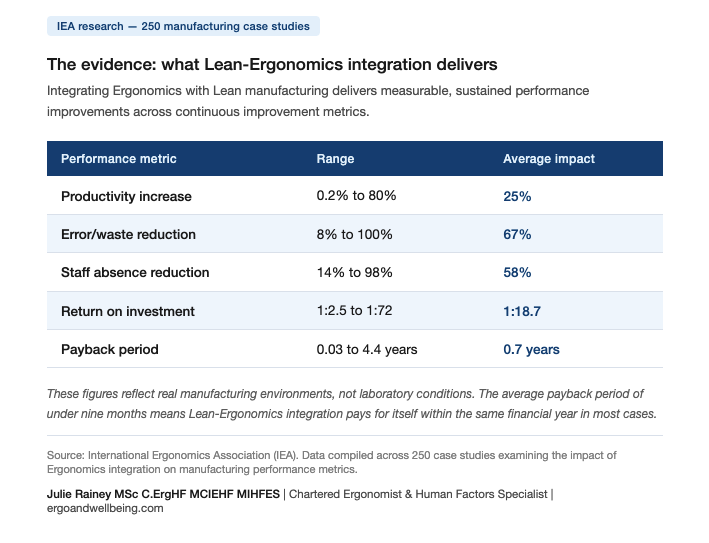
Source: International Ergonomics Association (IEA), compiled across 250 manufacturing case studies.
These figures reflect real manufacturing environments, not laboratory conditions. The average payback period of under nine months means Lean-Ergonomics integration pays for itself within the same financial year in most cases.
How Ergonomics integrates into your existing Lean tools
Ergonomics doesn't require a separate programme. It integrates directly into the tools you're already using.
Gemba walks with Ergonomic eyes: an opportunity to spot Ergonomic risk alongside process flow. Observe not just whether the process is running to standard, but whether workers are adopting awkward postures, reaching beyond comfortable limits, or compensating because the environment, tooling or equipment isn't quite right.
Kaizen events: does this change reduce physical strain? Efficiency-focused changes can increase physical demand on the worker. A faster cycle time means more repetitions. A reorganised layout can introduce more reaching or twisting. Considering Ergonomic impact before a change is implemented prevents problems appearing six months down the line.
5S plus Ergonomics: placement decisions made through 5S only sustain if they fit the people using them. Frequently used tools within comfortable reach, work surfaces at the right height, displays within comfortable sightlines, storage that doesn't require awkward postures. If the system doesn't fit the worker, they adapt around it and 5S discipline breaks down.
Value stream mapping with Ergonomic risk: most value stream maps capture process and time data but miss the physical demand placed on workers at each step. Adding Ergonomic risk identifies physical hotspots and whether bottlenecks are partly caused by strain rather than process inefficiency. Same map, fuller picture.
Lean + Ergonomics = Sustainable Performance
𝗟𝗲𝗮𝗻 𝗘𝗿𝗴𝗼𝗻𝗼𝗺𝗶𝗰𝘀: 𝘁𝗵𝗲 𝗵𝘂𝗺𝗮𝗻 𝘀𝗶𝗱𝗲 𝗼𝗳 𝗰𝗼𝗻𝘁𝗶𝗻𝘂𝗼𝘂𝘀 𝗶𝗺𝗽𝗿𝗼𝘃𝗲𝗺𝗲𝗻𝘁.
Lean Ergonomics is not a separate initiative. It is the missing layer in your existing continuous improvement programme, one that ensures your process gains are sustained because the people delivering them can sustain them.
If you're running a Lean programme and want to understand how Ergonomics can support it, I'd welcome a conversation.
Get in touch or find out more on the Lean Ergonomics page.
About the author
Julie Rainey MSc C.ErgHF MCIEHF MIHFES is a Chartered Ergonomist and Human Factors Specialist with experience across manufacturing, aerospace and automotive sectors, including Airbus UK and Aston Martin. Based in County Down, Northern Ireland.