Manufacturing facilities often face a dilemma: invest in worker health or maintain production efficiency. But what if the right Ergonomics intervention delivers both?
TMX Aerospace, a ThyssenKrupp division, demonstrates how a simple, low-cost solution eliminated injury risks while simultaneously improving workflow and product quality.
The Problem: Floor-Level Work Creating Multiple Risks
At TMX Aerospace's packaging department, forklifts delivered completed materials directly to the floor for quality checks, packaging and banding. The materials were placed randomly wherever space was available.
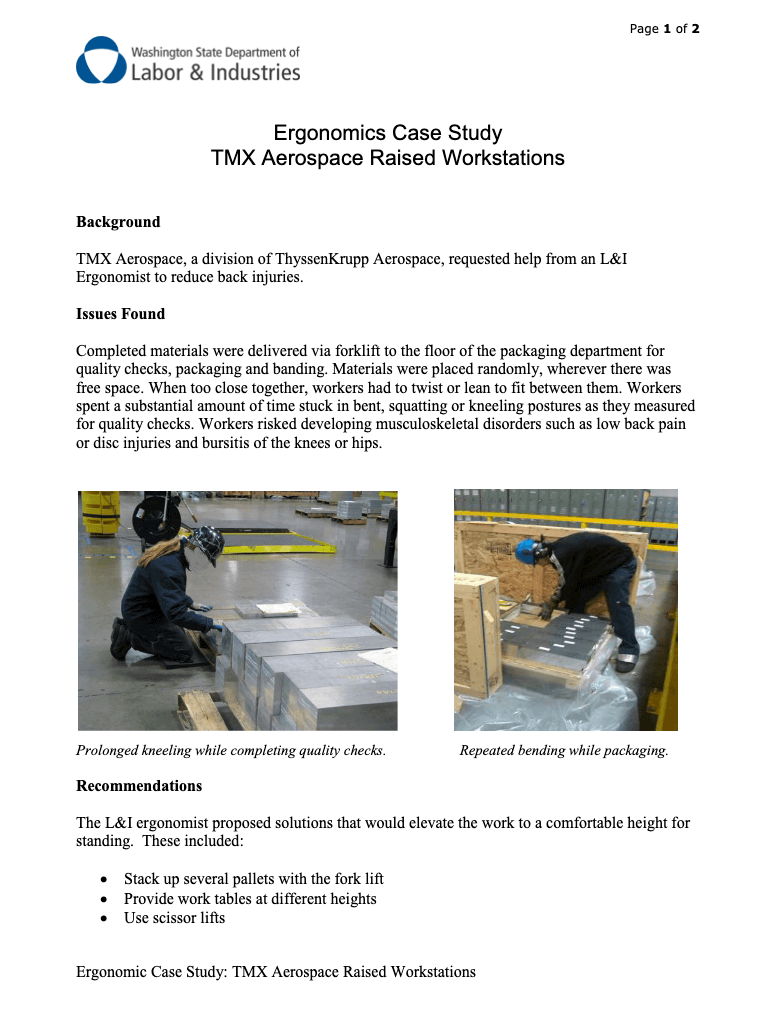
This created several problems:
Physical risks to workers:
Prolonged kneeling and squatting postures during quality checks
Repeated bending during packaging operations
Twisting and awkward reaching between randomly-placed materials
High risk of low back pain, disc injuries and knee/hip bursitis
Process inefficiencies:
Jobs worked in random order rather than correct sequence
Congestion from poor staging
Quality checks performed in uncomfortable, unstable positions
The situation is common across manufacturing: work positioned at floor level because "that's where the forklift puts it" rather than at an optimal height for the humans performing the task.
The Solution: Raise the Work to Standing Height
A Washington State L&I Ergonomist worked with TMX Aerospace to identify practical solutions:
Initial recommendations:
Stack multiple pallets with forklift to raise height
Provide work tables at various heights
Use scissor lifts
What actually worked:
Rather than purchasing expensive equipment, TMX Aerospace took a worker-centred approach:
Testing phase: Stacked pallets to various heights and had workers test them during actual operations
Worker input: Team identified three optimal heights that minimized bending for different tasks
In-house fabrication: Maintenance department built three pairs of sawhorses at the optimal heights
The solution was simple, cost-effective and precisely matched to the actual work being performed.
The Results: Safety AND Efficiency
Worker health improvements:
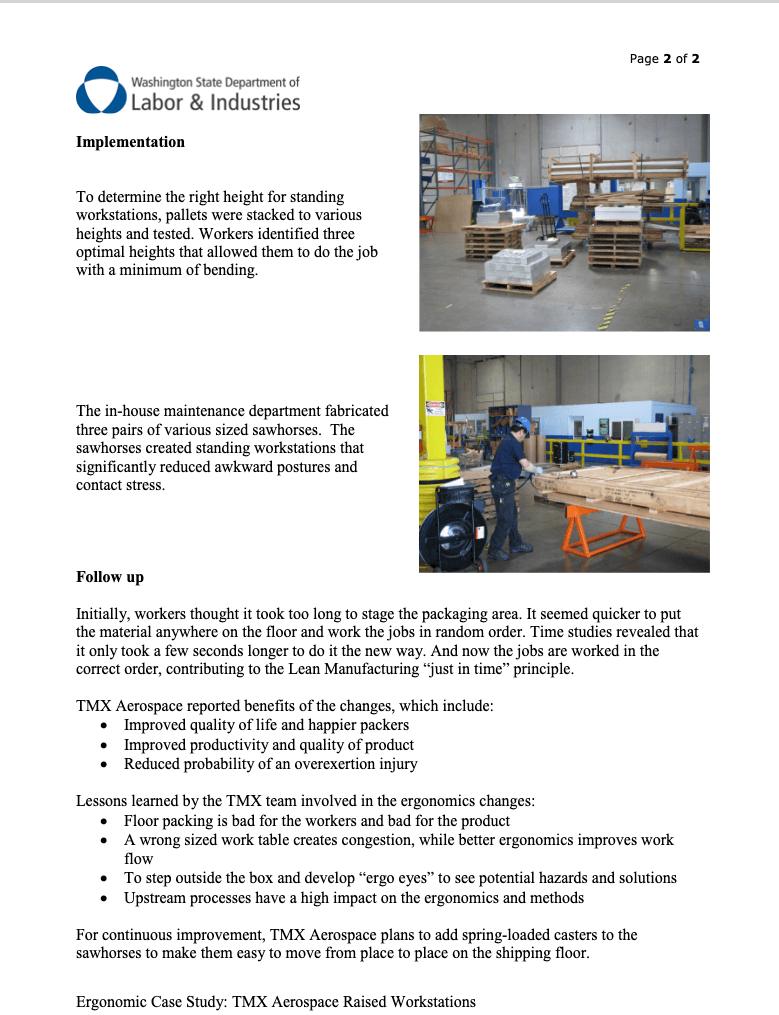
Eliminated prolonged kneeling and squatting
Reduced awkward postures and contact stress
Improved quality of life for packaging team
Reduced probability of overexertion injuries
Process improvements:
Jobs now worked in correct order
Supports just-in-time manufacturing principles
Improved product quality
Better workflow and reduced congestion
Overcoming Resistance: The Time Study That Changed Minds
Initial worker reaction: staging the area properly would take too long compared to random floor placement.
Time studies revealed: The new method added only a few seconds.
But those few seconds delivered jobs in the correct sequence, eliminating the downstream chaos of random work order. The marginal time investment in proper staging more than paid for itself in improved workflow.
This is a critical lesson: perceived efficiency often masks hidden inefficiencies. Floor work feels faster in the moment but creates problems throughout the system.
Key Principles for Manufacturing Ergonomics
The TMX Aerospace case demonstrates several important principles:
1. Worker involvement drives success Testing various heights with actual workers ensured the solution matched real needs, not theoretical ideals.
2. Simple solutions often work best Fabricated sawhorses, not expensive automation. The right tool for the job doesn't always come from a catalogue.
3. Good Ergonomics supports good manufacturing As TMX noted: "Floor packing is bad for the workers and bad for the product." Eliminating physical barriers often eliminates process barriers.
4. Upstream thinking matters "Upstream processes have a high impact on the Ergonomics and methods" - how materials arrive determines how workers must handle them.
5. Continuous improvement applies to Ergonomics TMX plans to add spring-loaded casters to the sawhorses for easier movement. Good enough today, better tomorrow.
The "Ergo Eyes" Mindset
TMX Aerospace's team learned to develop what they call "ergo eyes" - the ability to see potential hazards and solutions in everyday work processes.
This mindset shift is valuable: once you start seeing work from an Ergonomics perspective, opportunities for improvement become obvious. The forklift operator isn't just delivering materials - they're determining the working height for the next process. That's an Ergonomics decision with manufacturing implications.
Applying This to Your Operation
If workers in your facility spend significant time:
Kneeling or squatting during tasks
Bending repeatedly at floor level
Working in cramped or awkward positions
Consider the TMX approach:
Identify the optimal working height - test with workers, don't assume
Look for simple solutions first - can existing equipment be repurposed?
Involve workers in testing - they know what works in practice
Measure the real time impact - perceived slowdown often isn't real
Connect Ergonomics to process flow - how does worker positioning affect downstream operations?
Resources for Practical Ergonomics Solutions
The TMX Aerospace case study comes from the Washington State Department of Labor & Industries Ergonomic Ideas Bank - a searchable database containing:
121 success stories from real companies
78 tip sheets and checklists
272 tools and equipment solutions
Searchable by industry and risk factor
All solutions have been reviewed by L&I Ergonomists for validity. The database demonstrates that effective Ergonomics interventions are often simple, inexpensive and achieve payback in under a year.
Read the full TMX Aerospace case study here.
The Bottom Line
TMX Aerospace's experience proves that worker health and manufacturing efficiency aren't competing priorities.
Raising work to standing height eliminated injury risks, improved product quality, supported just-in-time workflow and created a better working environment. The investment? In-house fabrication time and materials.
Good Ergonomics doesn't slow down manufacturing. It removes the hidden inefficiencies that poor working conditions create.
Want to identify Ergonomics opportunities in your manufacturing operation? Get in touch to discuss how practical interventions can improve both worker health and operational performance.