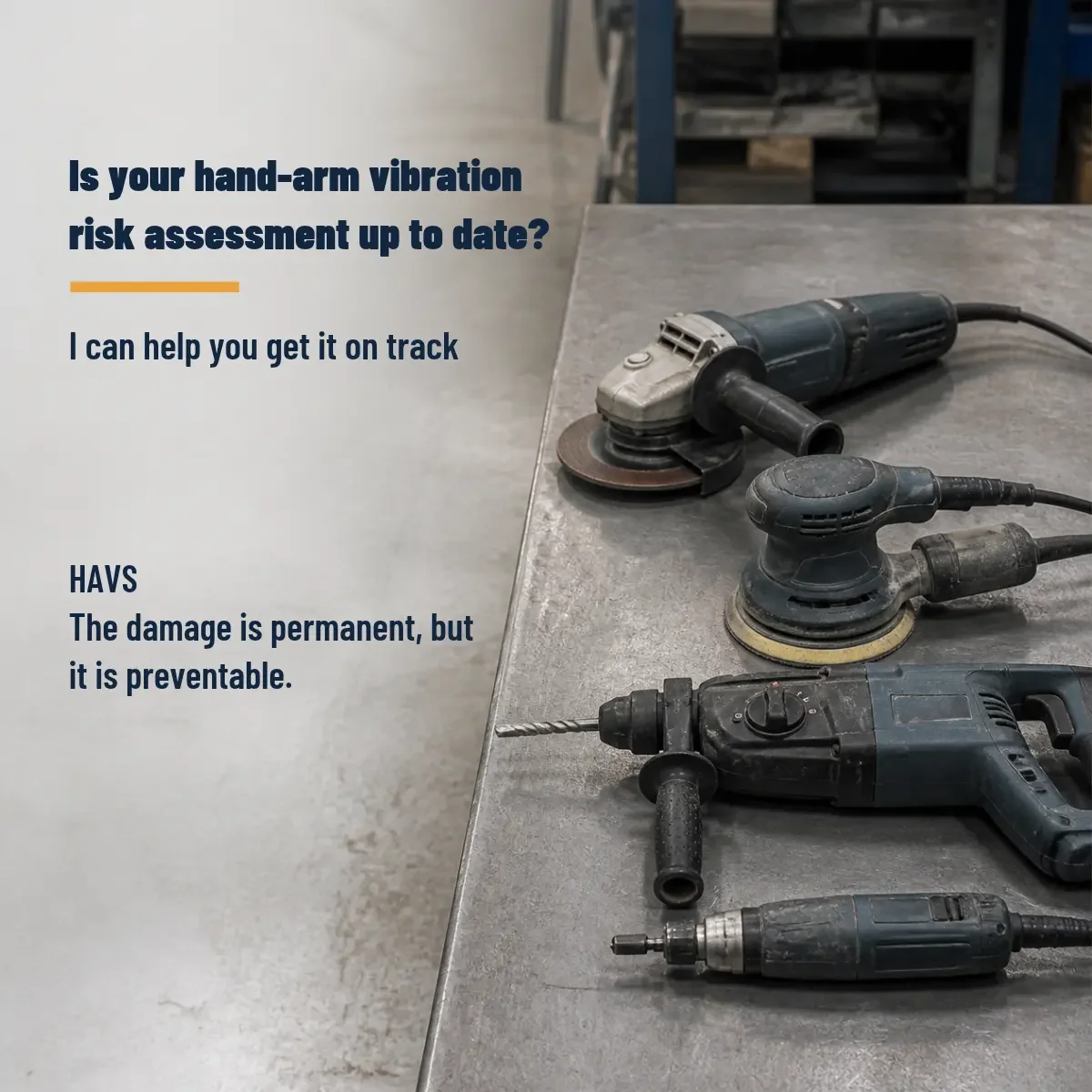
A hand-arm vibration (HAV) risk assessment is not a one-off document. Tools wear out or get replaced, tasks change and new people join. An assessment that was right when it was written can quickly stop reflecting how the work is done.
What the law requires
Regulation 5(4) of the Control of Vibration at Work Regulations (Northern Ireland) 2005 requires the risk assessment to be reviewed regularly. It must be reviewed straight away if:
there is reason to suspect it is no longer valid, or
there has been a significant change in the work it covers.
Where a review shows changes are needed, they must be made. The significant findings must then be recorded as soon as is practicable after the assessment is changed. Employers with five or more employees must keep a record of the assessment.
Signs your assessment needs reviewing now
HSE's guidance on the Regulations, L140, gives examples of when a review is needed:
A change to working processes. New tasks, products, materials or methods, or a change in how long people use vibrating tools.
A change in equipment. A change in the availability or suitability of equipment used to reduce exposure, such as new tools, replacement models or lower vibration equipment becoming available.
Doubt about controls. Any doubt about whether the controls in place are working.
Health surveillance findings. New cases of vibration-related disease, or existing cases getting worse.
Where an employee is diagnosed with a vibration-related condition, HSE guidance is to review the risk assessment and decide whether action is needed to protect the rest of the workforce. Others who have been similarly exposed should be placed under health surveillance.
How often is "regularly"?
The Regulations do not set a fixed interval. L140 states that reviews should be frequent enough to make sure changes in risk are picked up, taking account of:
the level of exposure
confidence that controls remain effective
the likelihood of better working methods or equipment becoming available
In practice, the higher the exposure and the less certain the controls, the sooner the next review should be. Even when nothing seems to have changed, HSE advises not leaving it more than about two years without checking whether a review is needed.
Using health surveillance results
If employees are under health surveillance for HAV, the grouped results from the occupational health provider are one of the best checks on whether controls are working. These should be anonymised so no individual can be identified. Employers should not hold confidential medical records, which stay with the occupational health provider.
What a review should cover
A review is a chance to check the whole picture, not just the exposure figures:
Is the assessment still accurate for the tools, tasks and people involved?
Have the planned controls been put in place, and are they working?
Are the right roles under health surveillance?
Have employees been given the information, instruction and training the Regulations require?
A review of existing arrangements
If your business already has a HAV risk assessment but it has not been looked at for a while, or things have changed, a review of existing arrangements checks whether it still meets the Regulations and HSE guidance. It looks at the assessment, controls, health surveillance arrangements and information and training and sets out what needs to change in a prioritised action plan.
As a Chartered Ergonomist, I also look at grip, posture and how the task and workstation are set up, as these are often where practical improvements are found.
Find out more about hand-arm vibration assessments, or get in touch to discuss a review of your current arrangements.