Ask most people what Ergonomics means and the answer is predictable. A better chair. A raised monitor. A standing desk. These are not wrong answers. They are just a fraction of the picture, and in manufacturing, engineering and industrial design, that fraction is costing organisations more than they realise.
Ergonomics and Human Factors is a systems discipline. It addresses the task, the individual and the environment and everything that sits within each. When it is applied well, it prevents injury before it occurs, improves productivity, reduces error and builds resilience into the systems and processes that organisations depend on. When it is underutilised or misunderstood, those gains are left on the table.
This article sets out what Ergonomics actually covers, why it matters in manufacturing and engineering contexts, and what organisations stand to gain by engaging with the full scope of the discipline.
What Ergonomics and Human Factors Actually Covers
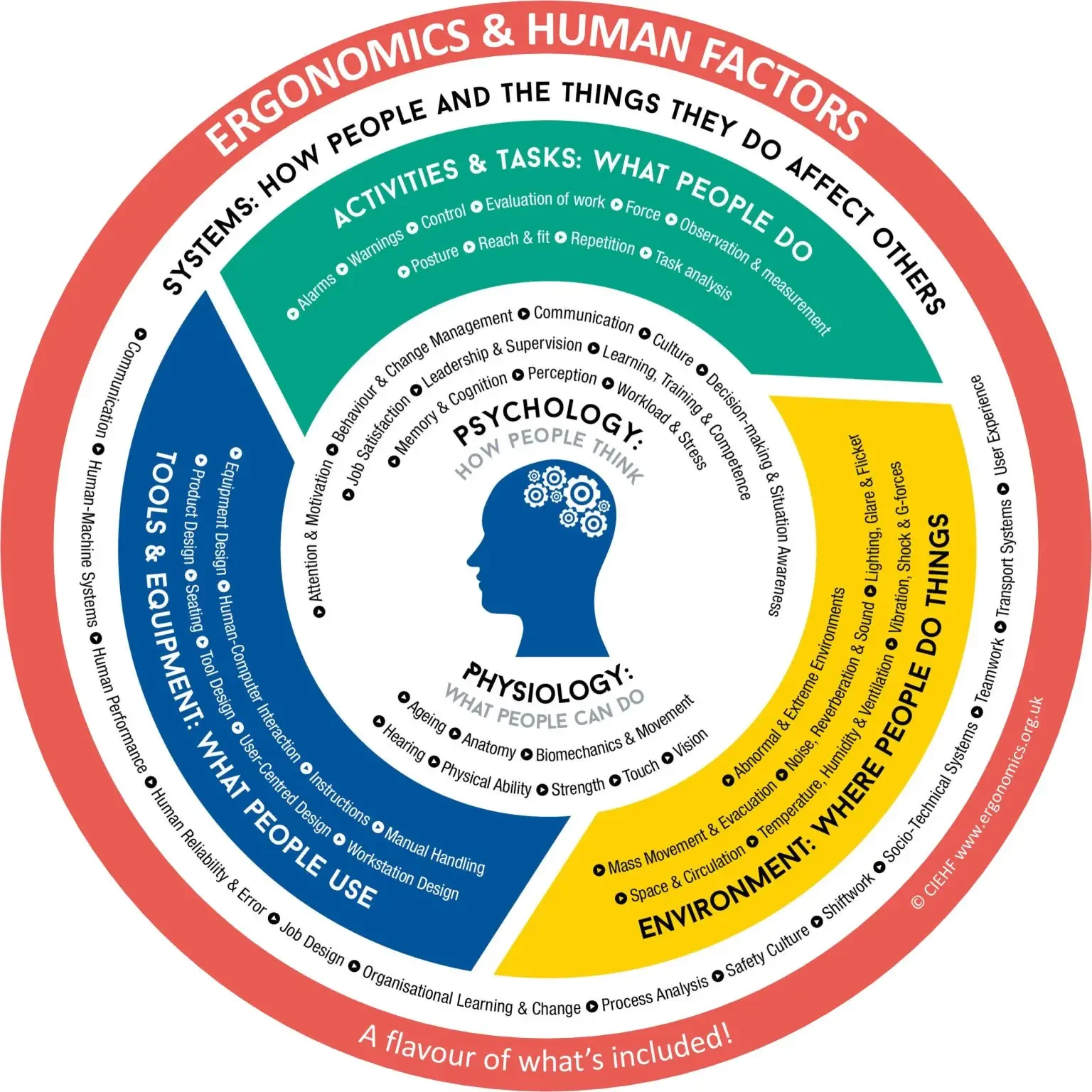
The CIEHF Ergonomics and Human Factors Wheel maps the full scope of the discipline across six interconnected domains. Together they cover the task, the individual and the environment. The six domains below show what sits within each.
What people do Task demands, posture, force, repetition and reach. In manufacturing and production environments, this is where musculoskeletal disorder risk is generated. The design of a task determines the load placed on the body. Getting this right at design stage is significantly less costly than correcting it after commissioning.
What people think Cognition, perception, workload, decision-making and situation awareness. In engineering and industrial design, the cognitive demands placed on operators are frequently underestimated. Complex interfaces, high task variety, time pressure and poor information design all increase the likelihood of error. Human Factors addresses these directly.
What people can do Capabilities, limitations, physiology, biomechanics, strength and physical ability. Effective manufacturing Ergonomics starts with an accurate understanding of what the workforce can and cannot do. That means accounting for variation across age, gender, stature and physical capacity, not designing for an idealised average that does not exist on the production floor.
What people use Tools, equipment design, workstation layout and human-machine systems. Industrial design that does not account for human interaction creates risk at the point of use. Tool weight, grip design, reach envelopes and control placement all influence whether a workstation supports or undermines the people working at it.
Where people work Environment, noise, lighting, temperature and shift patterns. Environmental conditions are rarely neutral. In food production, logistics and warehousing, workers operate across extremes of temperature, noise and physical demand. These factors compound physical and cognitive load in ways that standard risk assessment often fails to capture.
How people and the things they do affect others Behaviour, safety culture, organisational learning and socio-technical systems. This is where Ergonomics extends beyond the individual workstation to the wider system. How teams communicate, how errors are reported, how supervision is structured and how organisations learn from near misses are all within scope.
Why This Matters in Manufacturing and Engineering
Manufacturing Ergonomics is most valuable when it is embedded in the design process, not bolted on afterwards. In engineering design and industrial design contexts, decisions made early in a project determine the physical and cognitive demands placed on workers for the lifetime of that asset. Changing those decisions after commissioning is costly, disruptive and frequently incomplete.
The window to act is at design stage. That applies to production line layout, equipment specification, workstation design, tooling selection and interface design. Ergonomics input at this stage does not slow the process down. It prevents the failure modes that would slow it down later.
For manufacturers in Northern Ireland and across the UK, the business case is well evidenced. Work-related musculoskeletal disorders remain a leading cause of workplace absence, and manufacturing carries a disproportionate share of that burden. According to HSENI Workplace Health Statistics and Analysis for Northern Ireland 2025, an estimated 18,000 people suffer from work-related MSDs annually in Northern Ireland, resulting in around 260,000 lost working days. Manufacturing accounts for 13.5% of total MSD prevalence across all sectors, the third highest of any industry behind human health and social work and wholesale and retail trade. These are not inevitable costs. They are the consequence of systems designed without sufficient human factors input.
The Consequences of Underutilising Ergonomics
When Ergonomics is limited to a chair assessment or a manual handling training session, three things follow.
First, risk that sits outside that frame remains invisible. It has not been assessed and found acceptable. It simply has not been looked at.
Second, recurring problems such as injury rates that plateau, errors that persist and processes that consistently underperform get addressed at the symptom level rather than investigated at the system level. The root cause stays in place.
Third, design decisions about equipment, workflows, environments and interfaces get made without the human at the centre of them. The human is then retrofitted into a system that was not designed for them, which is always more expensive and less effective than designing for them from the outset.
What Full-Scope Ergonomics Looks Like in Practice
A full-scope Ergonomics review in a manufacturing or engineering context asks different questions from a standard risk assessment. It asks how cognitive demands are distributed across a task. It asks whether environmental conditions are creating load that compounds physical risk. It asks whether the design of a tool, interface or workstation is creating conditions for error or injury. It asks whether shift patterns, supervision and organisational culture are shaping behaviour in ways that standard assessment would not capture.
These are not abstract questions. They have direct answers, and those answers have direct consequences for performance, safety, absence and the long-term cost of work.
For engineers, production managers and operations leads working in manufacturing, food production, logistics or warehousing, Ergonomics is not a compliance requirement to be managed. It is a design discipline with measurable returns, and it belongs in the conversation from the start.
About the Author
Julie Rainey MSc C.ErgHF MCIEHF MIHFES is a Chartered Ergonomist and Human Factors Specialist supporting manufacturers and organisations across Northern Ireland and the UK with workplace assessments, production line optimisation and injury prevention.
If you want to understand what a full-scope Ergonomics review could offer your organisation, get in touch or book a discovery call via the website.