The Health and Safety Executive for Northern Ireland (HSENI) published its Workplace Health Statistics and Analysis booklet 2026 on 4th November 2026. Musculoskeletal disorders (MSDs) are conditions affecting the muscles, joints, tendons, ligaments and nerves, such as back pain, neck and shoulder problems or knee pain.
The latest figures, for 2024/25, show that work-related MSDs are rising in Northern Ireland, at a time when the figures for Great Britain are falling.
The Headline Figures: Northern Ireland, 2024/25
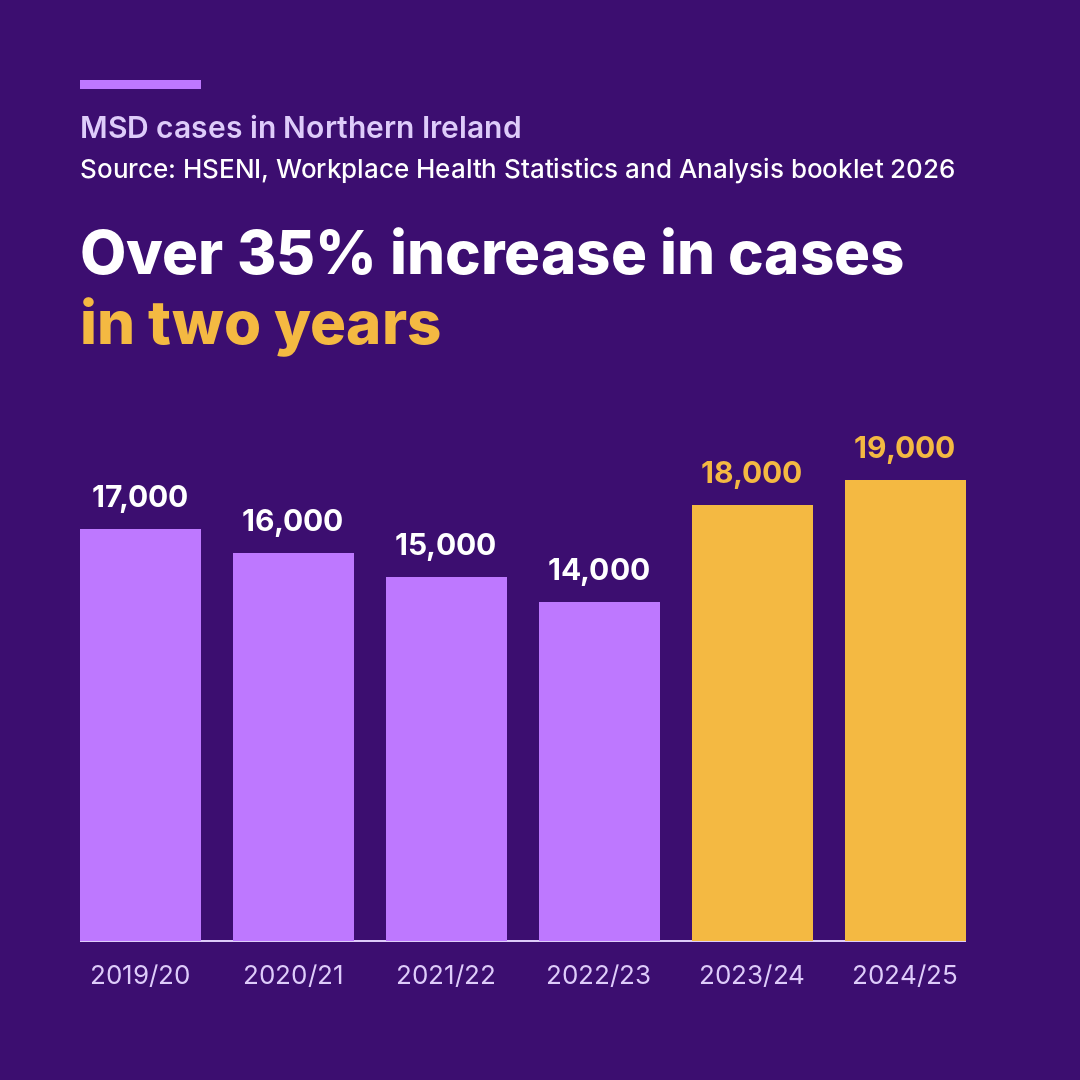
People with an MSD caused or made worse by work: 19,000, up from 18,000 in 2023/24
Change over two years: up over 35%, from 14,000 in 2022/23
Estimated working days lost to work-related MSDs: 250,000
MSDs were the most common type of work-related illness in Northern Ireland in 2024/25
Source: HSENI, Workplace Health Statistics and Analysis booklet 2026
These estimates come from the Northern Ireland Labour Force Survey, based on people who reported an illness caused or made worse by work in the last 12 months. HSENI advises that all its estimates should be treated with caution.
What's Changed
Two Years of Increases
Between 2019/20 and 2022/23, work-related MSD cases in Northern Ireland fell each year, from 17,000 to 14,000. Since then they have risen two years in a row, to 18,000 in 2023/24 and 19,000 in 2024/25. HSENI notes that the reasons for the increase are unknown.
Northern Ireland Is Moving in the Opposite Direction to Great Britain
Over their latest two years of data, MSD cases in Great Britain fell by 12%, from 543,000 to 477,000. In Northern Ireland, they rose by over 35%, from 14,000 to 19,000. The two sets of figures cover different years, because HSENI's data runs a year behind HSE's. GB's latest figures are for 2025/26, and Northern Ireland's are for 2024/25.
Working Days Lost
HSENI estimates that 250,000 working days were lost to work-related MSDs in Northern Ireland in 2024/25. Because there is no NI data on days lost per case, HSENI calculates this figure using GB's average days lost per case. It should be read as a guide to scale rather than a precise count.
What This Means for Businesses in Northern Ireland
The Cost of Work-Related Ill Health
HSENI does not publish a separate cost figure for MSDs. It estimates that workplace injuries and ill health together cost Northern Ireland around £647m each year, with work-related ill health alone costing close to £448m. As the most common type of work-related illness, MSDs make up a large part of that burden. For an individual business, the cost shows up as absence, reduced productivity, recruitment and cover, and potential claims.
Sectors Most Affected
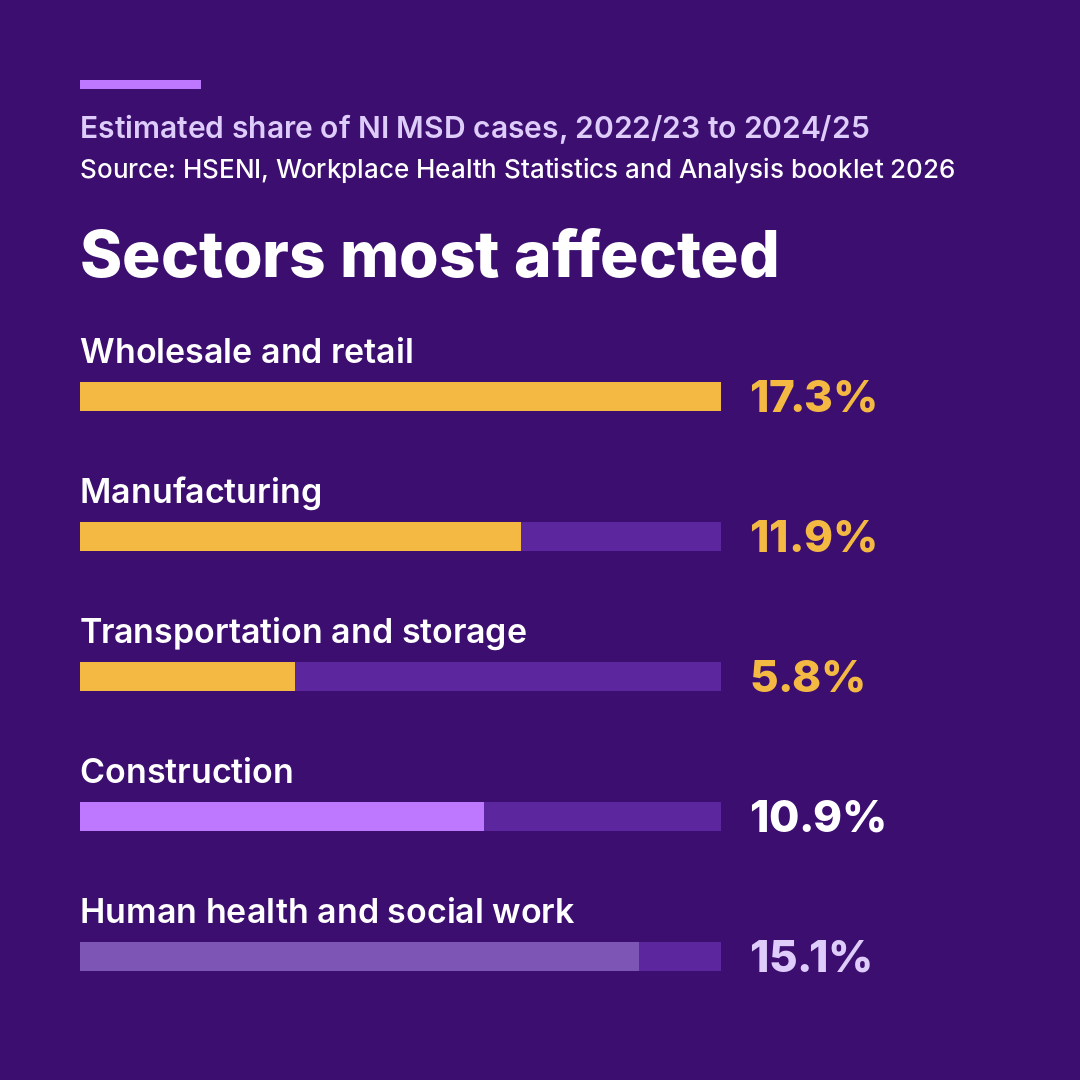
HSENI estimates the share of work-related MSD cases in each sector of the Northern Ireland economy (2022/23 to 2024/25). The largest are:
Wholesale and retail: 17.3%
Manufacturing: 11.9%
Transportation and storage: 5.8%
Construction: 10.9%
Administrative and support services: 9.3%
Education: 8.1%
Human health and social work: 15.1%
HSENI calculates these shares from GB data, adjusted for the number of jobs in each sector in Northern Ireland and they cover only the sectors where GB data is available. It stresses that workers in any sector can be affected by work-related MSDs.
If your business relies on manufacturing and production lines or retail and warehouse operations, these figures are directly relevant to your workforce.
Your Legal Duties
Employers in Northern Ireland have a legal duty to assess and reduce MSD risks. This includes the Manual Handling Operations Regulations (Northern Ireland) 1992 and the Health and Safety (Display Screen Equipment) Regulations (Northern Ireland) 1992, under the Health and Safety at Work (Northern Ireland) Order 1978.
Prevention: Where to Focus
Assess the task, not just the person. A structured workplace assessment identifies the risk factors in the job itself, such as force, repetition, posture and duration.
Provide appropriate, task-based manual handling training. Generic training rarely changes behaviour on its own. Manual handling training built around your actual tasks is far more effective.
Don't overlook desk-based work. Office and remote working setups need regular review, and DSE assessments are a legal requirement for regular users.
Check driving set-ups. A seat, steering wheel or mirrors that aren't adjusted correctly can leave drivers in awkward postures for long periods.
Build internal capability. Ergonomics Champions can spot problems early and keep improvements going between formal assessments.
Encourage early reporting. The longer a problem goes unreported, the longer the eventual absence is likely to be.
Why Chartered Ergonomist Expertise Matters
Chartered status from the Chartered Institute of Ergonomics & Human Factors (CIEHF) shows a recognised level of professional competence in assessing and designing work around people. As the only Chartered Ergonomist operating in Northern Ireland, I bring experience from production environments including Airbus UK and Aston Martin, as well as office and DSE settings. That experience helps me find the risk factors that generic assessments often miss, and recommend practical controls that work on the shop floor, at the desk and on the road.
Taking Action
Review your MSD risk assessments against current tasks, not last year's.
Look at your absence records for MSD-related patterns.
Make sure manual handling training is task-based and up to date.
Check that DSE assessments are in place for all regular users, including home and hybrid workers.
Get specialist support where the risks are complex or recurring.
If you would like to discuss MSD prevention in your workplace, Contact Julie Rainey.