Many employers assume a hand-arm vibration (HAV) risk assessment starts with someone measuring every tool. In most cases it does not. HSE guidance states that measurement of vibration magnitude will not usually be required.
Under the Control of Vibration at Work Regulations (Northern Ireland) 2005, employers must assess the risk from vibration and eliminate or reduce it as far as is reasonably practicable. The assessment needs a reasonable estimate of each person's daily exposure. It does not need a precise measurement of it.
What HSE guidance says
HSE's guidance on the Regulations, L140, sets out when measurement is and is not needed:
Measurement may be necessary if suitable vibration data is not readily available from HSE, equipment manufacturers or other reliable sources.
Measurement is not necessary if there is enough vibration and usage information to make a reasonable estimate of exposure. That means enough to show whether exposure is likely to be at or above the exposure action value (EAV) or below the exposure limit value (ELV), after allowing for uncertainty.
Representative vibration data and observed usage times are usually adequate to compare exposure with the EAV and ELV.
The EAV is 2.5 m/s² A(8) and the ELV is 5 m/s² A(8). The risk must still be controlled so far as is reasonably practicable at any level of exposure.
What is used instead of measurement
A daily exposure estimate needs two pieces of information: how much the tool vibrates in use and how long the hands are in contact with it.
Vibration data
L140 lists several sources of vibration data, including equipment handbooks, suppliers, online databases, trade associations and HSE's website. HSE provides vibration data for use in an initial risk assessment.
The data must be representative of the equipment and the way it is used. Figures taken at idle or under tightly controlled test conditions may not reflect real work. HSE advises comparing data from at least two sources and looking for an explanation where they differ.
Usage time
The second part is trigger time: how long each person actually operates each tool in a day. HSE notes that observing the work generally gives a much more accurate figure than asking employees to estimate it. Typical work patterns matter too, as some people only use vibrating tools for certain periods in a day or week.
When measurement can help
L140 identifies times when measurement is necessary:
when it is not clear from the available information whether daily exposure is likely to be at or below the EAV or ELV
when before and after measurements are needed to check whether controls have worked
when a machine is used for an unusual purpose that the manufacturer approves but cannot provide vibration information for
Measurement takes time to do properly. HSE notes it will usually be necessary to make many measurements for each tool to show that the results are more reliable than existing published data. Where it is needed, it should be carried out by a competent person, with Appendix 2 of L140 and BS EN ISO 5349-2 used for guidance.
The alternative to measuring
Where it is still uncertain whether exposure reaches the EAV, HSE guidance offers a simpler route. Rather than measure, the employer can assume the EAV is exceeded and go ahead with controls and health surveillance.
This often makes sense. A measurement report on its own does not reduce anyone's exposure. The controls do.
How this works in a HAV risk assessment
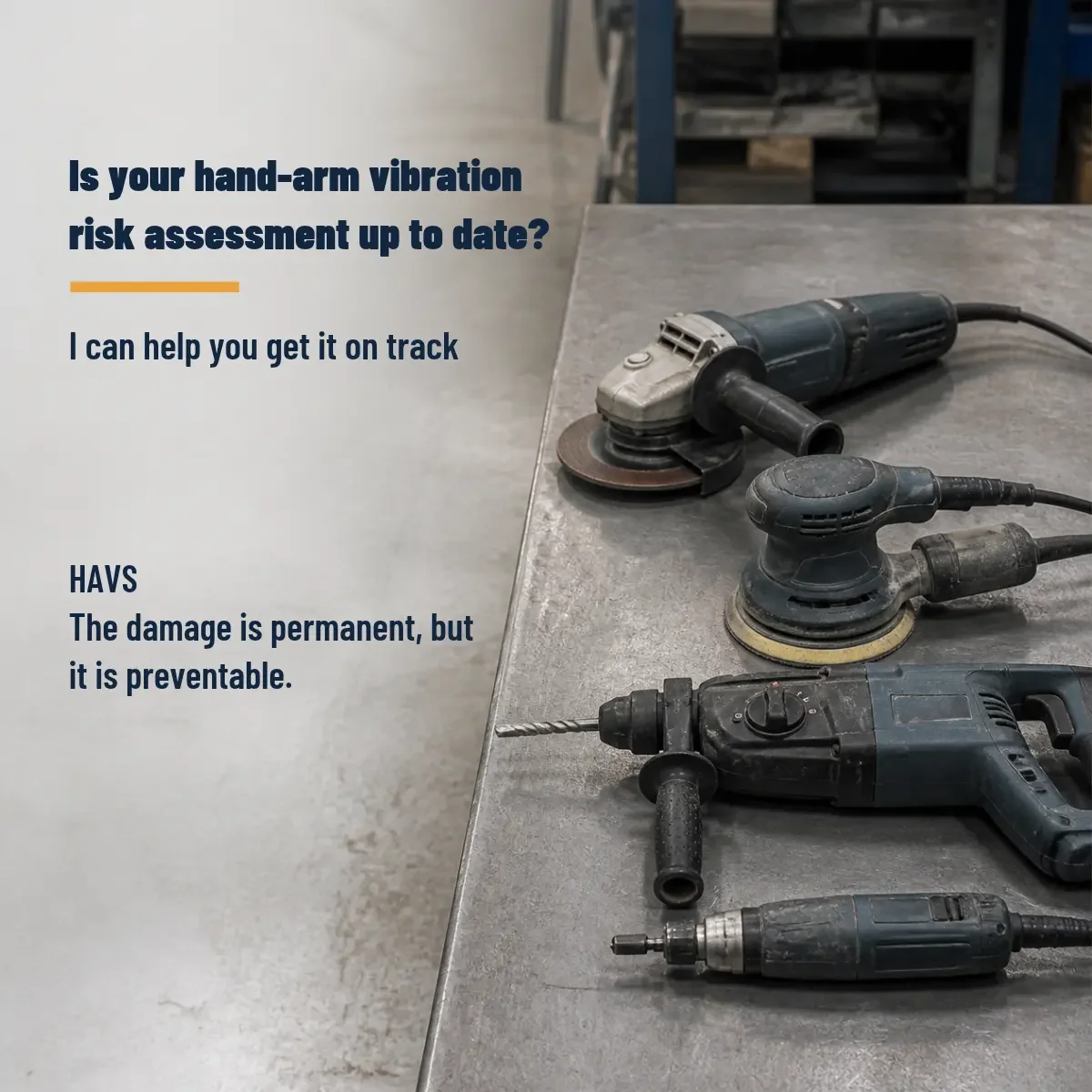
My HAV risk assessments estimate daily exposures from published in-use vibration data, cross-checked against other sources, and timed tool use. HSE guidance notes that exposure estimates carry an uncertainty of at least 20%. Where an estimate is close to the action or limit value, it is treated as exceeded. Where measurement would genuinely help, my report will say so and explain what it needs to answer.
As a Chartered Ergonomist, I also look at grip, posture and how the task and workstation are set up, as these affect the risk and are often where practical improvements are found.
Find out more about hand-arm vibration assessments, or get in touch to talk through vibration risk in your workplace.