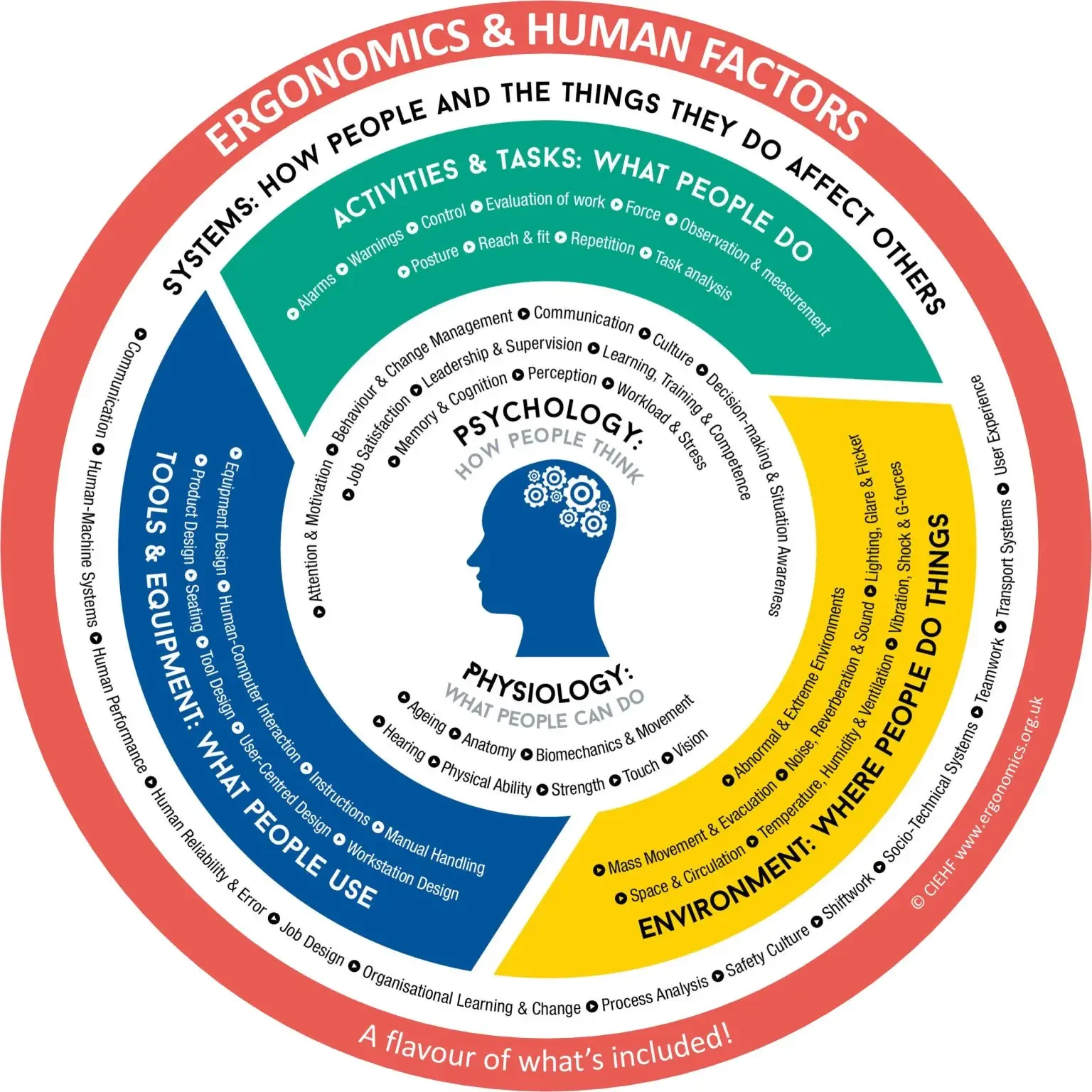
When organisations talk about improving safety culture, the conversation usually centres on leadership commitment, worker engagement and incident reporting. Ergonomics and Human Factors rarely get a mention. That is a significant gap, because the two are inseparable.
I recently watched a webinar hosted by TSO (The Stationery Office) and the Health and Safety Executive titled Achieving Safety Culture Excellence in the Manufacturing Industry, held on 27 May 2026. It was an excellent session, and as a Chartered Ergonomist working predominantly in manufacturing, one thing stood out clearly: everything the speakers described as a safety culture problem is also a Human Factors problem.
Here is why that matters for your organisation.
What Safety Culture Actually Measures

The webinar introduced HSE's Safety Climate Tool, a scientifically developed survey that measures employee attitudes and perceptions across eight health and safety factors:
Organisational commitment
Health and safety-oriented behaviours
Health and safety trust
Usability of procedures
Engagement in health and safety
Peer group attitude
Resources for health and safety
Accident and near miss reporting
Look at that list through a Human Factors lens and something becomes immediately clear. Every single factor describes how well the human-system interface is functioning - not at workstation level, but across the entire organisation. Usability of procedures is a classic Ergonomics concern. Are your safety rules written in a way that real people, under real working conditions, can actually follow? Resources for health and safety asks whether workers have the equipment, training and time they need to work safely. Accident and near miss reporting reflects whether your organisation has created the conditions for people to speak up without fear.
These are not abstract culture questions. They are Human Factors questions.
The Cost of Getting It Wrong
The scale of the problem is significant. According to HSE's Health and Safety at Work Summary Statistics 2025, 1.9 million workers in Great Britain are suffering from work-related ill health, with 511,000 affected by musculoskeletal disorders (MSDs) alone. The total annual cost of workplace injury and new cases of work-related ill health stands at £22.9 billion.
At an individual case level, the webinar presented figures that make the business case even starker: £19,300 per ill-health case, £12,200 per non-fatal injury and £1.9 million per fatality (TSO/HSE webinar, 27 May 2026).
MSDs are the second most common cause of work-related ill health in Great Britain. In manufacturing, the physical demands of production work, repetitive tasks, manual handling and awkward postures mean MSD risk is ever-present. Poor safety culture does not cause MSDs directly, but it creates the conditions in which MSD risk goes unrecognised, unreported and unaddressed.
Where Ergonomics and Human Factors Fit In
Human Factors is the scientific discipline that studies the relationship between people, their work and the systems around them. Its goal is to design work in a way that fits the human, rather than expecting humans to adapt to poorly designed systems.
Safety culture frameworks, including HSE's ASCENT model (Achieving Safety Culture Excellence Now and Tomorrow) presented at the webinar, are built on exactly the same principle. The ASCENT framework moves through five stages: Foundation, Analyse, Focus, Act and Evaluate. At every stage, the methods used are recognisable to any Human Factors practitioner.
The Analyse stage uses structured survey data to identify where the system is failing people. The Focus stage engages workers directly, through interviews and focus groups, to understand why problems exist and what solutions they would suggest. This is participatory design, a cornerstone of Ergonomics practice. The Act stage develops targeted interventions. The Evaluate stage measures whether those interventions have worked and adjusts accordingly if they have not.
This is not coincidental. Both disciplines share the same foundational insight: when something goes wrong at work, the answer is rarely a failure of the individual. It is a failure of the system that person was working within.
What This Means in Practice for Manufacturing
The prosecution cases cited in the webinar illustrated two patterns that will be familiar to anyone working in manufacturing health and safety. In the first, productivity was prioritised over adequate training, and an incident occurred. In the second, a risk assessment identified the need for control measures, but they were never implemented.
Both are systems failures. Both are Human Factors failures. And both are preventable.
Ergonomics risk assessments, whether manual handling risk assessments using HSE tools such as MAC, RAPP and ART or AI-powered MSD risk assessment, generate exactly the kind of data that organisations need to populate the action planning stage of a safety culture programme. They move the conversation from "we know there is a risk" to "here is the specific task, here is the risk level and here is what needs to change."
Near miss reporting, highlighted in the webinar as an area where many organisations can make quick gains, is particularly relevant here. In manufacturing, MSD cases are frequently preceded by months of unreported discomfort. Workers adapt, push through and do not report because the culture does not make it easy or safe to do so. A strong safety culture, supported by proper Ergonomics risk assessment, changes that.
The Bigger Picture
If your organisation is working through a safety culture improvement programme, Ergonomics and Human Factors should be part of it from the start, not added on as an afterthought or considered a 'nice to have'.
At the foundation stage, an Ergonomist can help identify the physical and organisational risk factors that are most likely to be driving poor safety perceptions. At the analysis stage, MSD risk assessment data provides objective evidence to sit alongside survey results. At the focus stage, task analysis and participatory approaches help workers articulate what is not working and why. At the evaluation stage, reassessment data shows whether interventions have made a measurable difference.
Safety culture improvement and Ergonomics are not competing priorities. They are the same priority, approached from different angles.
If you would like to discuss how an Ergonomics review can support your organisation's safety culture programme, I would be glad to help. I offer a range of services to support manufacturing organisations at every stage, from a Workplace Ergonomics Walk-Through or Site Ergonomics Survey to identify where risk is concentrated, through to comprehensive Ergonomics Risk Assessments that provide the task-level evidence needed to build a targeted action plan.
Sources:
HSE Health and Safety at Work Summary Statistics for Great Britain 2025: https://www.hse.gov.uk/statistics/assets/docs/hssh2425.pdf
TSO/HSE Webinar: Achieving Safety Culture Excellence in the Manufacturing Industry, 27 May 2026. Recording: https://williamslea.zoom.us/rec/share/wE1wlFN7spFy0Di3mdPuG0NrJ2LIc0i99M-RVgJmdCZUzZeIXOYsosbw4_HEdo3P.3pnKm5DehJTJn2G_
HSE Safety Climate Tool: https://books.hse.gov.uk/safety-climate-tool-sct