The Lean Ergonomics Advantage:
Where worker wellbeing & process efficiency drive performance
Integrating Ergonomics with Lean
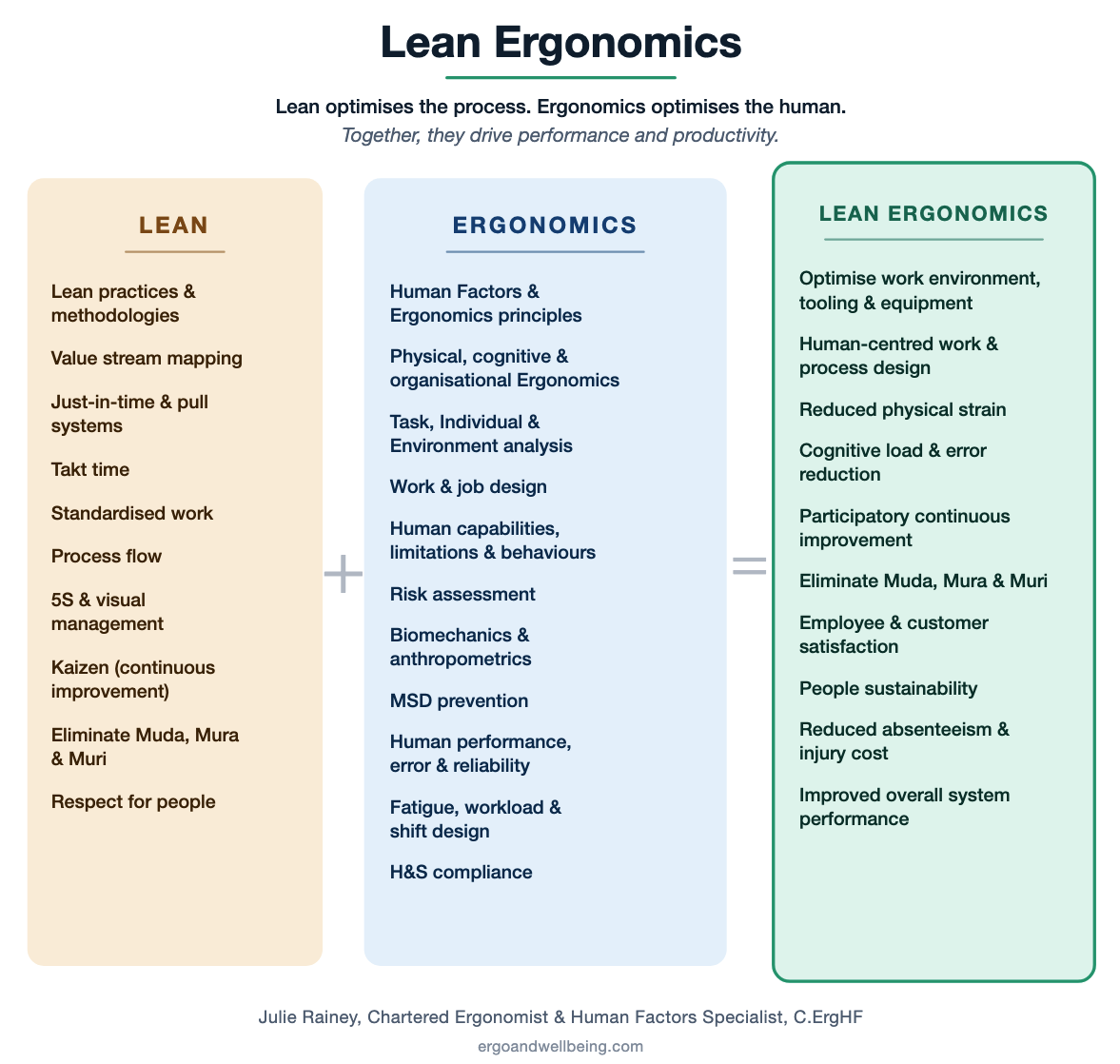
I integrate Ergonomics with Lean manufacturing principles. Most businesses treat these as separate disciplines, but they share the same goal: eliminating waste, improving efficiency and optimising performance. By addressing them through your existing Lean tools (Gemba walks, Kaizen events, 5S, Poka-Yoke) you achieve better outcomes with less disruption.
The benefits
✓ Reduce waste: Poor Ergonomic design creates Muda (lost time), Mura (inconsistency from fatigue) and Muri (overburdening workers). Addressing these through Lean principles eliminates multiple forms of waste simultaneously.
✓ Improve productivity: When workers aren't fighting their work environment, productivity naturally increases. Optimised workspaces reduce fatigue and unnecessary movements, leading to faster cycle times.
✓ Enhance quality: Less fatigued workers perform better and make fewer errors. Integrating Ergonomics into your quality improvement processes creates sustainable improvements in output quality.
✓ Boost employee satisfaction: Workers feel valued when their wellbeing is considered in process design. This leads to better engagement, reduced absenteeism and improved retention.
✓ Achieve people sustainability: Sustainable operations require sustainable people. Lean Ergonomics ensures your workforce can maintain performance levels without physical degradation over time.
✓ Optimise system performance: When you measure Overall Equipment Effectiveness (OEE) alongside human effectiveness, you see the complete picture and can optimise your entire system for peak performance.
What are Muda, Mura and Muri?
Muda (waste): unnecessary reaching, excessive walking to retrieve tools, time lost to injury and absence. When workers are fighting a poorly designed work environment, every task takes longer than it should. Non-value-adding movement accumulates across a shift, and when injury or absence follows, the waste compounds further.
Mura (unevenness / inconsistency): a worker performing well at the start of a shift but slowing and making errors as fatigue sets in. The process hasn't changed. The standard work hasn't changed. But the output quality and speed vary because the physical demand is unsustainable over time. Inconsistency in human performance is often a signal of poor Ergonomic design, not a process flaw.
Muri (overburden): workstations, environments and equipment that exceed human capability, forcing awkward postures, excessive force or repetitive strain. Workers being asked to do more than their body is designed to sustain. Muri is often invisible in process data because it doesn't show up until it becomes an injury, an absence or a quality problem.
The three are connected. Muri causes Mura, and Mura creates Muda. Lean traditionally focuses on eliminating Muda, but if the Muri at the workstation level isn't addressed, the waste keeps coming back.
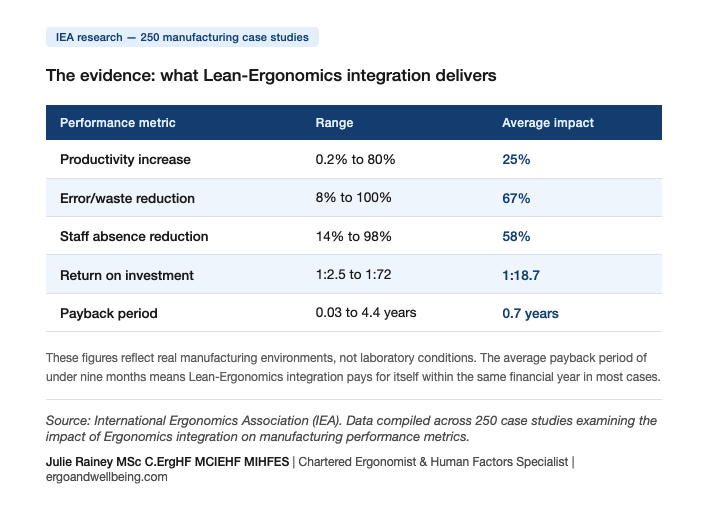
Integrating Ergonomics with Lean manufacturing delivers measurable, sustained performance improvements. Research published by the International Ergonomics Association (IEA) across 250 case studies demonstrates the impact on continuous improvement metrics:
What this looks like in practice
Results from documented Lean-Ergonomics integration programmes include:
System productivity gains of 30–800% through Lean-Ergonomics framework integration, alongside a 60% reduction in manufacturing floor space
Emergency sign manufacturing: 20% productivity increase in print assembly, 40% in final assembly, with 25% reduction in rework and 40% reduction in order lead time
Average programme outcomes: 45% system productivity improvement, 8% rework reduction and 3–5% waste reduction
Source: ‘Giving your business the human factors edge’ IEA.
How Ergonomics integrates into your existing Lean tools
Ergonomics doesn't require a separate programme. It integrates directly into the tools you're already using.
Gemba walks with Ergonomics eyes: an opportunity to spot Ergonomics risks alongside process flow. Observe not just whether the process is running to standard, but whether workers are adopting awkward postures, reaching beyond comfortable limits, or compensating because the environment, tooling or equipment isn't quite right.
Kaizen events: does this change reduce physical strain? Efficiency-focused changes can increase physical demand on the worker. A faster cycle time means more repetitions. A reorganised layout can introduce more reaching or twisting. Considering Ergonomics impact before a change is implemented prevents problems appearing six months down the line.
5S plus Ergonomics: placement decisions made through 5S only sustain if they fit the people using them. Frequently used tools within comfortable reach, work surfaces at the right height, displays within comfortable sightlines, storage that doesn't require awkward postures. If the system doesn't fit the worker, they adapt around it and 5S discipline breaks down.
Value stream mapping with Ergonomics risk: most value stream maps capture process and time data but miss the physical demand placed on workers at each step. Adding Ergonomic risk identifies physical hotspots and whether bottlenecks are partly caused by strain rather than process inefficiency. Same map, fuller picture.
Error-proofing workstations to prevent strain: design workstations where poor posture is physically difficult, not just discouraged through training.
Kanban that asks: are workers fatigued? Is the physical demand too high? Is repetitive strain slowing them down?
Ready to integrate Ergonomics into your Lean programme?
Whether you need support with a specific project, want to train your Lean champions to recognise Ergonomic risks, or are looking for a Lean-Ergonomics review of your production environment, I can help.