
UK Ergonomics Compliance: Legal Requirements

Understanding your legal obligations for workplace Ergonomics is essential for protecting your workforce and ensuring compliance with UK health and safety law. Work-related musculoskeletal disorders affect over half a million workers annually, making Ergonomics compliance both a legal duty and a business priority.
📥 Download our quick reference guide: “UK Ergonomics Compliance - Your Legal Obligations” A concise breakdown of mandatory regulations, the hierarchy of controls, when assessments are required and the consequences of non-compliance.
Legal Framework
UK Ergonomics compliance is governed by the Health and Safety at Work etc. Act 1974, with enforcement by the Health and Safety Executive (HSE) in Great Britain and the Health and Safety Executive for Northern Ireland (HSENI) in Northern Ireland. Employers must assess and mitigate workplace risks "so far as is reasonably practicable."
Key Regulations
Management of Health and Safety at Work Regulations 1999 Risk assessment mandatory, with written health and safety policies required for businesses with five or more employees. Risk assessments must be reviewed when circumstances change. HSE guidance recommends reviewing at least annually.
Manual Handling Operations Regulations 1992 Avoid hazardous manual handling where reasonably practicable, assess unavoidable risks and reduce to lowest possible level.
Display Screen Equipment Regulations 1992 DSE assessments required for significant computer users, covering office, remote and hybrid setups. Employers must provide ergonomic equipment where necessary, eye tests on request and training.
Workplace (Health, Safety and Welfare) Regulations 1992 Basic welfare requirements including suitable seating, workspace and environmental conditions.
Provision and Use of Work Equipment Regulations (PUWER) 1998 Safe work equipment provision, maintenance and training.
Reporting of Injuries, Diseases and Dangerous Occurrences Regulations (RIDDOR) RIDDOR 2013 applies in Great Britain whilst RIDDOR 1997 applies in Northern Ireland. Northern Ireland regulations are stricter, requiring reporting of injuries causing absence over 3 days versus 7 days in Great Britain. Records must be kept for a minimum of 3 years.
HSE and HSENI Guidance
The HSE and HSENI provide comprehensive guidance documents to support compliance:
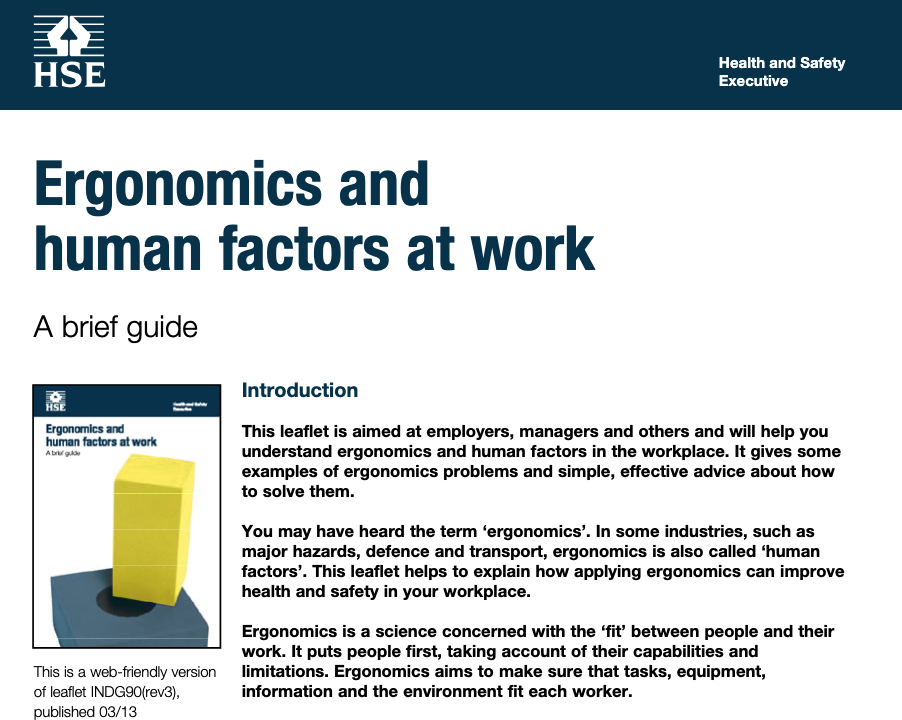
INDG90: Ergonomics and human factors at work
MAC Tool: Manual Handling Assessment Charts for risk assessment
L22: PUWER Approved Code of Practice and guidance
INDG143: Manual Handling at Work - A Brief Guide
Ensuring Compliance
Compliance with these regulations requires:
Comprehensive workplace Ergonomic risk assessments
Written health and safety policies for businesses with five or more employees
Regular review and updating of risk assessments
Appropriate training for employees on manual handling, DSE use and equipment operation
Provision of suitable equipment and workstation modifications where necessary
Accurate record-keeping of incidents and risk assessments
Compliance prevents musculoskeletal disorders, protects against legal claims and avoids enforcement action.
Expert Support
As Northern Ireland's only Chartered Ergonomist, Ergo & Wellbeing provides specialist expertise in Ergonomics compliance for businesses across Northern Ireland, the rest of the UK. Our comprehensive workplace assessments identify regulatory requirements specific to your operations and provide evidence-based recommendations for compliance.
Contact us to discuss your Ergonomics compliance requirements.